You've probably seen it in a spec sheet. A number like 112 or 124 sitting next to "swing weight" with no explanation of what it means or whether you should care. Most paddle listings don't even include it. And yet swing weight — more than static weight, more than thickness, more than face material — is the single spec that most directly determines how a paddle feels in your hand during play.
Here's what it actually means, why it matters, and how to use it when choosing your next paddle.
What Swing Weight Is (And What It Isn't)
Static weight is simple: it's how much the paddle weighs on a scale. A 7.8 oz paddle weighs 7.8 oz. Full stop.
Swing weight is different. It measures the paddle's resistance to rotation as you swing it — specifically, how much torque your wrist and arm must generate to change the paddle's angular velocity during a stroke. The technical term is *moment of inertia* (MOI), measured about the pitch axis at a pivot point near the base of the handle.
The critical insight: two paddles can weigh exactly the same and feel completely different to swing. A paddle with most of its mass concentrated in the head will have a much higher swing weight than a paddle of equal static weight where the mass sits closer to the grip. The scale can't tell you that. Only swing weight can.
How It's Measured
Swing weight is measured using a swing weight machine — essentially a precision pendulum that oscillates the paddle about a fixed pivot point and calculates MOI from the period of oscillation. The pivot point is typically set 5 cm (about 2 inches) above the butt of the handle, approximating where the center of your palm sits when you grip the paddle naturally.
The result is expressed in kg-cm² (metric) or oz-in² (imperial). Most paddle reviewers and manufacturers use kg-cm², with typical pickleball paddle swing weights falling between 70 and 130 kg-cm². A few reference points:
| Swing Weight (kg-cm²) | Feel | Best For |
|---|---|---|
| Below 85 | Very maneuverable, light feel | Dinking specialists, players with arm issues, beginners |
| 85–100 | Balanced, moderate feel | All-court players, intermediate to advanced |
| 100–115 | Slightly heavier, more plow-through | Aggressive baseliners, power players |
| Above 115 | Heavy feel, significant stability | Hard-hitters, players who want maximum drive power |
These are general ranges. Individual preference varies significantly, and what feels heavy to one player may feel perfectly balanced to another.
Why It Matters More Than Static Weight
Here's the practical reality: when you're at the kitchen line reacting to a fast hands battle, you're not thinking about how much your paddle weighs in ounces. You're thinking about whether you can get the paddle face where it needs to be in time. That's swing weight.
A high swing weight paddle requires more effort to redirect quickly. It will feel sluggish in fast exchanges at the net. But it also carries more momentum through contact — which means more power on drives and more stability when you hit off-center.
A low swing weight paddle moves fast. You can flick it, redirect it, and reset it with minimal effort. The tradeoff is that it requires more precise contact to generate power, and it's more susceptible to being pushed around by hard shots.
The common mistake: players buy a light paddle (low static weight) thinking it will be easy to maneuver, then wonder why it still feels heavy. If the mass is distributed toward the head, the swing weight can still be quite high regardless of what the scale says.
Swing Weight vs. Twist Weight
Swing weight gets most of the attention, but twist weight is its equally important sibling. Where swing weight measures resistance to rotation on the vertical axis (up-down swing), twist weight measures resistance to rotation on the horizontal axis — the paddle twisting in your hand when you hit off-center.
A paddle with high twist weight will stay more stable on mishits. The ball won't deflect as much when you catch the edge of the sweet spot. This is why some paddles that feel "forgiving" aren't necessarily the lightest or slowest — they have a high twist weight that keeps the face square even on imperfect contact.
The two specs work together. Ideally you want a paddle whose swing weight matches your play style *and* whose twist weight gives you the stability you need for your level of ball-striking consistency.
How Paddle Shape Affects Swing Weight
Shape is one of the biggest drivers of swing weight, and it's why elongated paddles almost always have higher swing weights than widebody paddles at the same static weight.
In an elongated paddle, mass is distributed further from the pivot point (your hand). Because swing weight scales with the *square* of the distance from the pivot, even a small shift in mass distribution toward the head creates a disproportionately large increase in swing weight. This is also why adding lead tape to the top of a paddle has such a dramatic effect — a few grams at 10 inches from the pivot adds far more swing weight than the same grams added at the throat.
| Shape | Typical Effect on Swing Weight |
|---|---|
| Widebody (short, wide) | Lower swing weight — more maneuverable |
| Hybrid (standard) | Moderate swing weight — balanced |
| Elongated | Higher swing weight — more power, less speed |
How to Use This When Buying a Paddle
Most paddle listings still don't publish swing weight. But a growing number of reviewers — including Paddle Lab at JustPaddles and Pickleball Science — measure and publish swing weight data for popular paddles. Before buying, it's worth checking those databases.
If you can't find published data, use shape and balance point as proxies:
- - Balance point above center (head-heavy) → higher swing weight
- - Balance point below center (handle-heavy) → lower swing weight
- - Elongated shape → higher swing weight than the static weight suggests
- - Widebody shape → lower swing weight than the static weight suggests
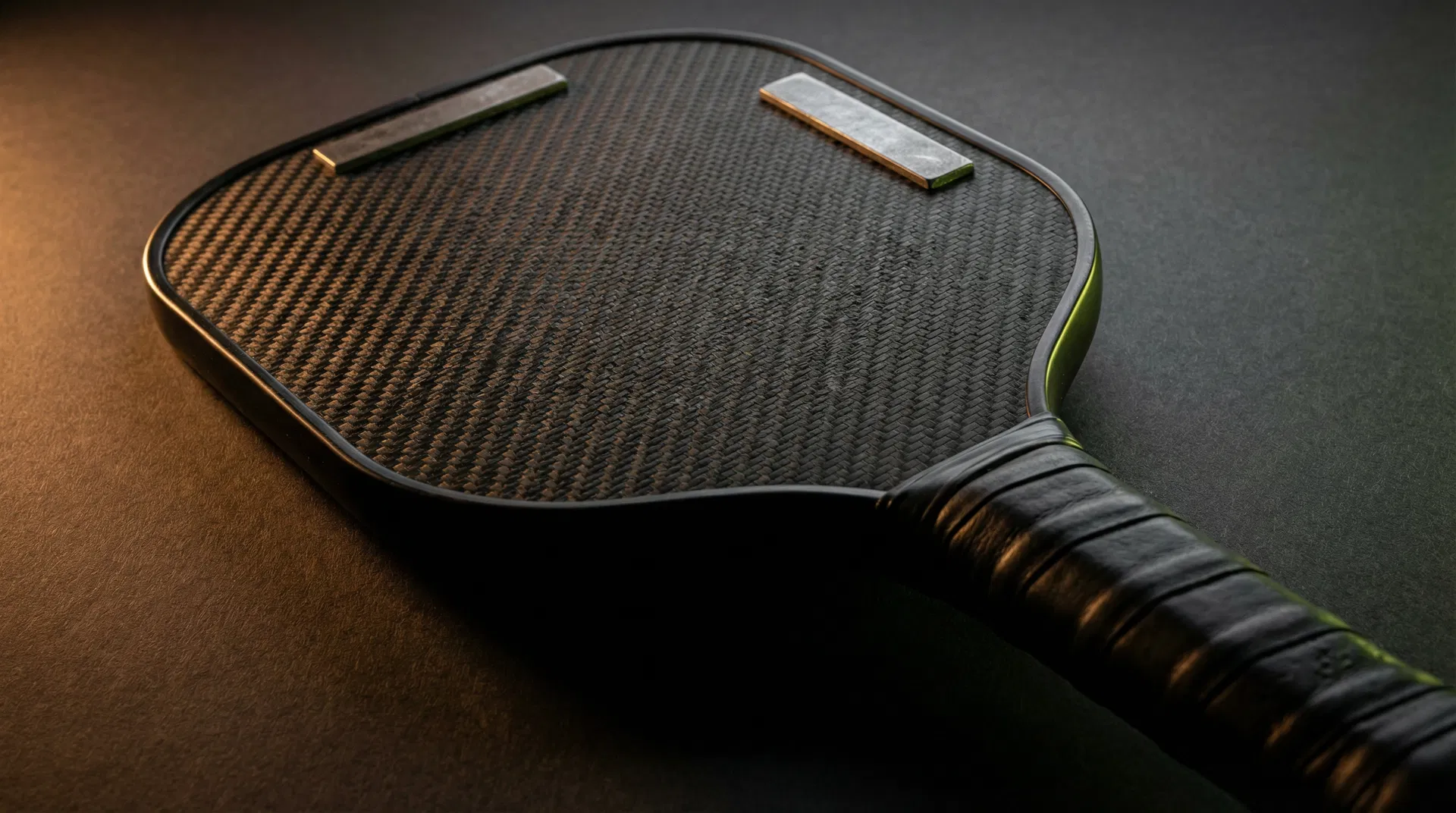
And if you already own a paddle and want to adjust its swing weight without buying a new one — that's where lead tape comes in. A few strips at the 3 and 9 o'clock positions (sides of the head) will raise swing weight and add stability without dramatically changing the balance point. Tape at 12 o'clock (top of the head) raises swing weight more aggressively and shifts the balance point upward.
The Bottom Line
Swing weight is the spec that explains why paddles that look similar on paper feel completely different in your hand. It's the difference between a paddle that lets you reset at the kitchen and one that lets you drive from the baseline. Understanding it won't make you a better player overnight — but it will make you a much smarter paddle buyer.
If you're unsure where to start, come into either Spinwave location and demo a few paddles back to back. We can walk you through the feel differences and help you find the swing weight range that matches your game.